Skip to content


Municipal sanitation departments and commercial waste operators face a recurring math problem: uncompressed refuse takes up far more truck space than it needs to, which means more collection trips, more fuel spent, and more labor hours just moving air and empty volume from point to point. On top of that, fixed compaction stations require civil construction — foundation work, permitting, and a permanent site — before they can even begin operating.
Mobile waste compression stations were developed specifically to remove both of these constraints. Understanding what actually makes this type of equipment effective — and where civil construction requirements typically get in the way — helps clarify what to look for before selecting one for a sanitation operation.
1. Why Uncompacted Waste Collection Gets Expensive Fast
Collection trucks have a fixed volume capacity, and loose, uncompacted waste fills that space quickly without maximizing the actual payload weight being carried. This means more trips back and forth to the transfer or disposal site, which directly increases fuel consumption, vehicle wear, and the labor hours required to complete a collection route.
Over time, these inefficiencies compound across a sanitation fleet, making volume reduction at the point of collection one of the more direct ways to control operating costs.
2. Why Fixed Compaction Stations Aren’t Always Practical
Traditional waste compaction infrastructure typically requires foundation excavation, permitting, and fixed civil construction before a single unit becomes operational. For municipalities or commercial sites that need compaction capability quickly — or in locations where permanent construction isn’t feasible — this upfront requirement can delay deployment by months.
This is where a mobile, integrated design changes the equation, allowing compaction capability to be deployed directly on level ground without the construction timeline attached to fixed installations.
3. What to Confirm Before Choosing a Mobile Compression Station
Before comparing equipment, it’s worth clarifying a few operational details specific to your collection area:
- What is the daily volume of waste generated at the site?
- Is the installation site residential, commercial, or industrial?
- What compaction density is needed to meet transport efficiency goals?
- Is leachate containment a regulatory requirement in your area?
- What power supply is available at the deployment location?
These answers determine whether a station’s capacity and compaction ratio will genuinely reduce collection trips for your specific site, rather than just looking efficient on a spec sheet.
4. Compaction Ratio Directly Affects Collection Costs
The higher the compaction density a station can achieve, the fewer transport trips are needed to move the same volume of waste. A hydraulic compression mechanism with automatic feeding and compaction, coordinated by a PLC electrical control system, keeps each compaction cycle stable and consistent — producing dense, uniform blocks that maximize the payload of every collection trip.
This directly translates to fewer trips required for the same volume of waste, which lowers both fuel consumption and the labor cost associated with each additional transport run.
5. Sealed, Closed-Loop Operation Matters for Sensitive Locations
Waste compaction near residential or commercial areas comes with added scrutiny around odor, scattering, and liquid runoff. A fully sealed enclosure that contains the compression process throughout both compaction and storage helps prevent waste scattering and odor dispersion, while a dedicated leachate collection chamber captures liquid runoff before it reaches surrounding ground surfaces.
This closed-loop design is often what determines whether a station can be sited in areas where sanitation standards and public comfort are a higher priority, such as residential neighborhoods or commercial districts.
6. Introducing This Mobile Waste Compression Station
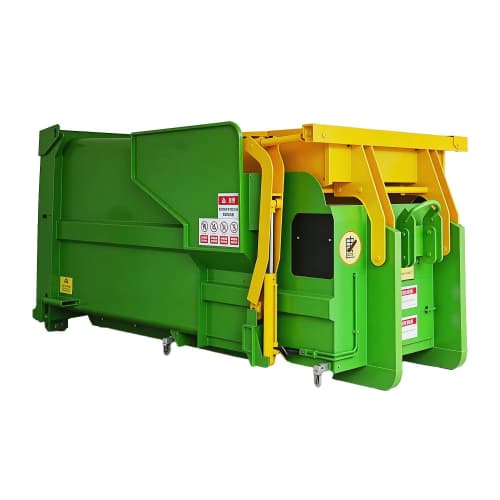
Built as a fully integrated refuse collection unit, this mobile waste compression station requires no foundation excavation or fixed civil construction, allowing rapid deployment on any level ground surface. The hydraulic compression mechanism, intelligent PLC control system, leachate collection chamber, and sealed enclosure are all housed within a single transportable body — meaning the station is operational as soon as it’s positioned on site.
The unit achieves a compaction density of ≥0.75 t/m³ with a capacity of 18 L, running on 380V, 50Hz power at 7.5 kW (10.06 hp). It operates via unidirectional rotation and includes overload protection to safeguard the hydraulic system during continuous operation. Built in a rectangular prism shape with overall dimensions of 6340 × 2500 × 2560 mm, the station weighs 1500 kg and comes with a 1-year warranty.
Its fully sealed compression process prevents waste scattering, odor dispersion, and leachate dripping throughout compaction and storage, making it suitable for installation in residential and commercial areas where environmental and sanitation standards are strictly enforced.
7. Key Specifications
| Specification | Details |
|---|---|
| Type | Refuse Collector |
| Capacity | 18 L |
| Compaction Density | ≥0.75 t/m³ |
| Power | 7.5 kW (10.06 hp) |
| Voltage / Frequency | 380V, 50Hz |
| Rotation Method | Unidirectional rotation |
| Overload Protection | Yes |
| Overall Dimensions | 6340 × 2500 × 2560 mm |
| Weight | 1500 kg |
| Warranty | 1 year |
8. Is This the Right Fit for Your Sanitation Operation?
If your municipality or commercial site is currently spending too much on collection trips due to uncompacted waste volume, or if a fixed compaction station isn’t feasible due to construction timelines or site constraints, this mobile station is designed to solve both problems at once. Its all-in-one integrated design, sealed closed-loop operation, and dependable compaction ratio make it well suited for residential, commercial, and industrial waste management applications, and it’s backed by video technical support and a full machinery test report.
Get a Quote or Request a Test Run
Send us your daily waste volume, site type, and power supply details, and we’ll confirm whether this station fits your operation. We can also arrange a demo video or share the full machinery test report before you order.
Myway Machinery
Brand: Myway
Email: sales@syplastech.com