Skip to content


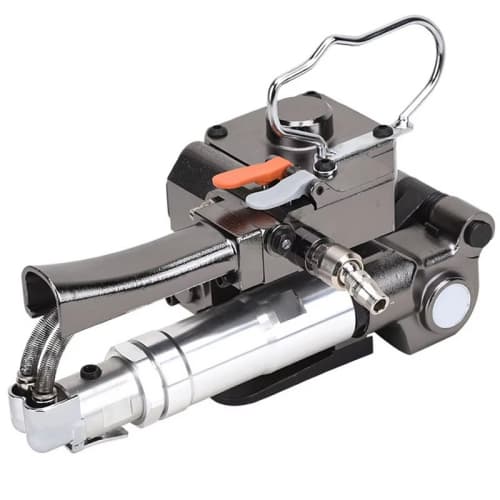
Facilities that already run compressed air lines — for pneumatic tools, conveyors, or other equipment — often overlook a simple opportunity: that same air supply can power strapping tools too. Instead of relying on battery charge cycles or manual buckle tensioners, a pneumatic strapping tool draws directly from existing compressed air, delivering consistent tightening force without downtime for recharging.
Before choosing one for a strapping station, it's worth understanding what actually makes a pneumatic strapper reliable for repeated, high-frequency use.
1. Why Battery Runtime Isn't Always the Best Fit
Battery-powered strapping tools work well for mobile, on-site jobs, but they come with a built-in limitation: eventually the battery needs to recharge, and that means downtime or swapping tools mid-shift. In facilities where strapping happens continuously at a fixed station — near an existing compressed air line — this recharge cycle is an avoidable inefficiency.
Pneumatic tools sidestep this entirely. As long as the air supply is running, the tool keeps working, with no charge time and no battery degradation to worry about over years of daily use.
2. What to Confirm Before Choosing a Pneumatic Strapping Tool
Pneumatic strappers are built around a specific strap type and air supply requirement, so it helps to confirm these details first:
- What air pressure does your compressed air line supply?
- What strap material and width do you currently use — PP belt or plastic-steel belt?
- How much tightening force does your load require?
- How many straps need to be applied per shift?
- Does the job require a lightweight, portable tool, or a fixed station setup?
Matching these details to a tool's rated air pressure standard and strap compatibility ensures the tool performs consistently rather than underdelivering on tension or wearing out prematurely.
3. One-Button Operation Reduces Training Time
Tools that combine tightening, welding, and cutting into a single trigger action are significantly easier to hand off to new operators than tools requiring multiple manual steps. One-button operation also reduces the chance of user error — there's no separate buckle to align or manual cut to make, which keeps strap quality consistent regardless of who's running the tool that day.
This matters most in facilities with rotating staff or seasonal labor, where extensive tool training isn't always practical.
4. Friction Welding Eliminates the Need for Buckles
As with electric strapping tools, friction welding fuses the two strap ends together directly, removing the need for metal buckles or separate fasteners. This not only cuts down on consumable cost per strap but also produces a cleaner, safer finish — no exposed metal edges that could snag during handling or storage.
Combined with automatic banding, this also helps prevent misuse — the tool completes the full cycle on its own once triggered, rather than relying on an operator to manually judge when tension and sealing are complete.
5. Lightweight Design Matters for Repeated Daily Use
A strapping tool used dozens or hundreds of times per shift needs to be comfortable to hold for extended periods. A lightweight, portable handheld design reduces operator fatigue over a full workday, which in turn helps maintain consistent tensioning quality from the first strap to the last.
6. Introducing This Pneumatic Strapping Machine
Designed for facilities with an existing compressed air supply, this pneumatic strapping tool uses an air-driven motor to tighten, weld, and cut the strap in a single trigger action — no packing buckle required. The pull-tight-and-catch mechanism completes the entire strapping cycle with one-button operation, making it straightforward for operators of any experience level to use consistently.
The tool delivers a tightening force of 3500 N and runs on an air pressure standard of 0.5–0.8 MPa, compatible with both PP belt and plastic-steel belt in strap sizes of 13, 16, or 19 mm at 0.5–1.5 mm thickness. Sealing is completed through friction welding, fusing the strap ends together without buckles. Weighing just 5 kg with dimensions of 280 × 180 × 160 mm, it's built as a lightweight, portable handheld tool — simple to lift, carry, and put back down between strapping cycles.
With automatic banding built into the design, the tool helps prevent misuse while maintaining even, consistent tension across every strap — a practical fit for facilities already equipped with compressed air and looking to speed up repetitive strapping work.
7. Key Specifications
| Specification | Details |
|---|---|
| Product Name | Pneumatic Strapping Machine |
| Driven Type | Pneumatic |
| Automatic Grade | Semi-Automatic |
| Tightening Force | 3500 N |
| Air Pressure Standard | 0.5–0.8 MPa |
| Applicable Strapping | PP belt, plastic-steel belt |
| Strap Size | 13 / 16 / 19 mm, thickness 0.5–1.5 mm |
| Sticking Method | Friction welding |
| Weight | 5 kg |
| Dimensions | 280 × 180 × 160 mm |
8. Is This the Right Fit for Your Facility?
If your facility already runs compressed air lines and you're looking to speed up repetitive strapping without dealing with battery charge cycles, this pneumatic tool is a straightforward fit. Its one-button operation, lightweight build, and buckle-free friction welding make it well suited for high-frequency strapping stations, and it's backed by online support and video technical support for setup guidance.
Get a Quote or Request a Test Run
Send us your available air pressure, strap material, and daily strapping volume, and we'll confirm whether this tool fits your setup. We can also arrange a demo video or share the full machinery test report before you order.
Myway Machinery
Brand: Myway
Email: sales@syplastech.com