Skip to content


Single cartons don't always need a full-scale pallet wrapping line, but they still need protection from dust, moisture, and surface abrasion during handling and transit. For businesses shipping individual boxes of food, beverage, glassware, or ceramics, manually wrapping each carton is slow, inconsistent, and hard to scale once order volume increases.
This gap between manual wrapping and full pallet wrapping systems is exactly where small carton wrapping machines fit in. Understanding what these machines actually need to handle — and where their limits are — makes it easier to judge whether one fits your packing line.
1. Why Single-Carton Wrapping Gets Overlooked
Most stretch wrapping equipment on the market is built for pallet loads — large turntables, tall uprights, heavy-duty film carriages designed for stacked, palletized freight. But a lot of packaging operations don't need to wrap pallets; they need to wrap individual cartons, one at a time, before they're boxed, shipped, or placed into storage.
Trying to use a pallet-scale wrapper for single cartons is inefficient and often impractical given the size mismatch. At the same time, doing it by hand doesn't scale well once daily volume climbs past a certain point, and manual wrap quality varies from one operator to the next.
2. Questions to Answer Before Choosing a Machine
Small carton wrappers are built around a specific product size range, so it's worth clarifying these points before comparing machines:
- What are the smallest and largest carton dimensions you need to wrap?
- What is the maximum carton weight the turntable needs to support?
- How many cartons need wrapping per hour?
- Does your product need a specific film thickness for protection?
- Is the packaging line automatic, or does it need operator loading between cycles?
Getting clear on these details upfront makes it far easier to confirm whether a machine's wrapping range and turntable capacity will actually match daily production needs.
3. Wrapping Product Size Range Determines Real Usability
A common oversight when evaluating small carton wrappers is assuming any "small" machine will fit any "small" carton. In practice, wrapping range varies between models, and a machine needs to comfortably cover both your smallest and largest carton — not just an average size — to be genuinely useful across your product mix.
This matters especially for businesses packing varied SKUs, where carton dimensions can shift from one order to the next. A wider wrapping range reduces the chance of needing a second machine for oversized or undersized cartons.
4. Film Thickness and Rotary Speed Affect Wrap Quality
Not all products need the same level of film protection. Fragile items like glassware or ceramics typically benefit from a thicker film setting, while lighter, more durable products can be wrapped with a thinner film to reduce material cost. A machine with an adjustable film carriage that covers a wider micron range gives operators the flexibility to match film thickness to the product being wrapped.
Rotary speed plays a similar role — an adjustable turntable speed allows slower rotation for delicate items and faster cycles for sturdier cartons, rather than forcing every product through the same fixed wrap speed.
5. PLC Programs Simplify Repeat Production
For operations wrapping the same product repeatedly, a PLC-based control system removes the need to manually reset wrap settings for every cycle. Once a wrap program is set for a specific carton type, the machine can repeat it consistently, which keeps output uniform whether the operator running the line is highly experienced or new to the role.
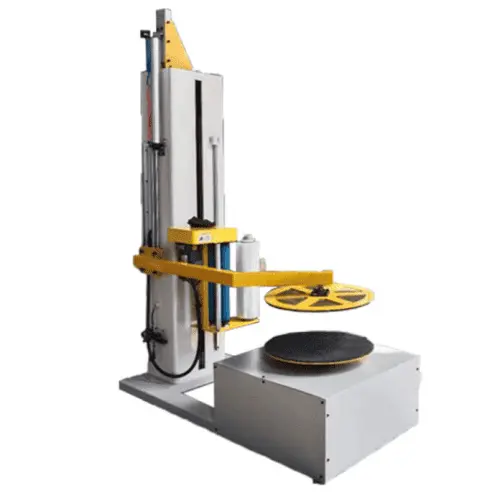
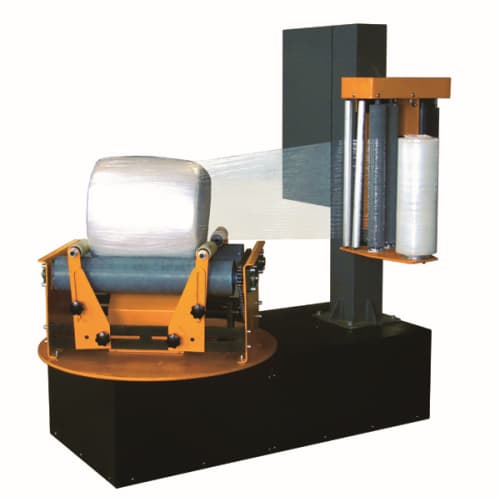
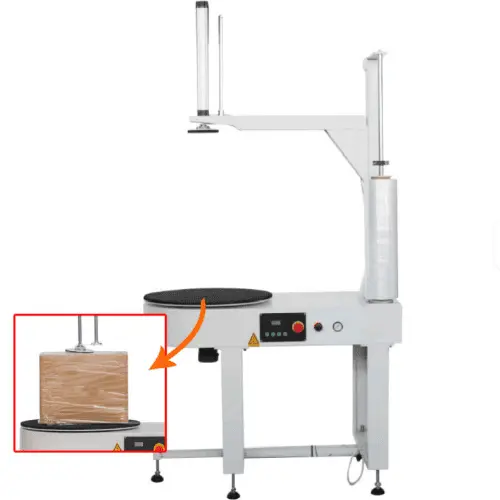
6. Introducing This Small Carton Box Wrapping Machine
Built specifically for single-carton wrapping rather than pallet loads, this semi-automatic machine is widely used across food, beverage, glass, and ceramics packaging, where dustproof and moisture-proof protection matters as much as presentation. It's designed to handle individual cartons efficiently without the footprint or complexity of a full pallet wrapping system.
The machine covers a wrapping product size range of L100–900 mm × W100–900 mm × H100–900 mm, with a turntable weight capacity of 80 kg — enough range to handle most single-carton formats without needing a separate machine for size variation. Packing efficiency is rated at 50–80 cycles per hour, with a rotary speed of up to 30 r/min, adjustable to suit different carton weights and film settings.
Its film carriage supports stretch film widths of 100–900 mm at 15–35 microns, giving operators flexibility between lighter and heavier-duty wrapping. The PLC control program allows wrap settings to be repeated consistently across production runs, and the machine carries CE certification for compliance in export markets.
7. Key Specifications
| Specification | Details |
|---|---|
| Packaging Type | Small Carton Box Wrapping Machine |
| Automatic Grade | Semi-Automatic |
| Wrapping Product Size | L100–900 × W100–900 × H100–900 mm |
| Packing Efficiency | 50–80 pieces/hour |
| Rotary Speed | Up to 30 r/min, adjustable |
| Turntable Weight Capacity | 80 kg |
| Film Carriage | 100–900 mm width, 15–35 μm |
| Machine Size | 1150 × 600 × 1860 mm |
| Certification | CE |
8. Is This the Right Fit for Your Packing Line?
If your team is currently wrapping individual cartons by hand — or considering a pallet wrapper that's oversized for your actual product — this machine is built for that middle ground. Its wide size range, adjustable rotary speed, and repeatable PLC settings make it suited for fragile or presentation-sensitive products like glass and ceramics, while remaining compact enough for a standard packing station. Field installation, commissioning, training, and ongoing maintenance support are included.
Get a Quote or Request a Test Run
Send us your carton size range, weight, and target hourly output, and we'll confirm whether this machine fits your packing line. We can also arrange a demo video or share the full machinery test report before you order.
Myway Machinery
Brand: Myway
Email: sales@syplastech.com