Skip to content


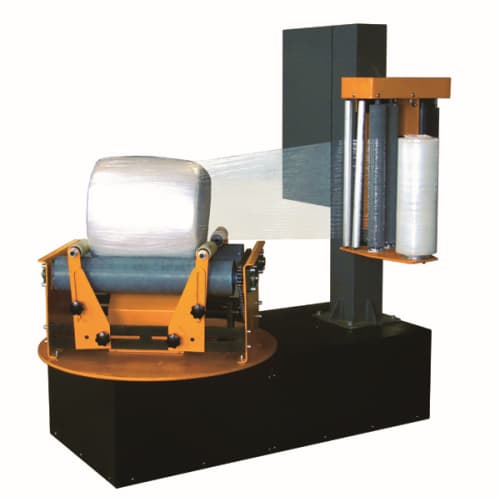
Cylindrical rolls — paper rolls, cord fabric, non-woven fabric, and similar products — present a packaging challenge that flat cartons don't. Their round shape makes them difficult to wrap evenly by hand, and any gap or loose section in the film leaves the roll exposed to moisture, dust, and abrasion during transport and storage.
For manufacturers shipping these products in volume, this is why rotary roll wrapping machines have become a standard part of the packing line rather than an optional upgrade. Before selecting one, it's worth understanding what actually determines whether a wrapper performs well on a specific product range.
1. Why Cylindrical Products Are Hard to Wrap Consistently
A round or cylindrical roll doesn't have flat surfaces for film to grip against evenly. Manual wrapping tends to leave uneven tension across the roll — tighter in some sections, looser in others — which creates weak points where the film can tear or shift during handling.
This unevenness becomes a real problem in industries like paper making, cord fabric, and non-woven fabric production, where rolls often travel long distances before reaching the end customer. A poorly wrapped roll picks up moisture at the seams and edges, and dust accumulation over time can affect product quality upon arrival.
2. What to Confirm Before Choosing a Roll Wrapping Machine
Roll wrapping equipment varies significantly depending on the product range it's built for. Before comparing machines, it helps to clarify a few points about your own production line:
- What is the diameter and width range of your rolls?
- What is the maximum roll weight the turntable needs to support?
- How many rolls need to be wrapped per hour?
- Does wrapping tension or layer count need to be adjustable between product types?
- What power supply is available at the packing station?
These details determine whether a wrapper's turntable capacity and speed range will actually match your daily output, rather than just looking sufficient on a spec sheet.
3. Turntable Speed and Capacity Define What the Machine Can Actually Handle
A rotary wrapping machine works by rotating the roll on a turntable while the film carriage moves along its length, so turntable speed and load capacity directly determine both wrapping quality and daily throughput. A turntable rated for variable speed control allows operators to slow down for heavier or more delicate rolls and speed up for lighter, standard-size products — rather than running every roll at a single fixed speed.
Turntable capacity also matters more than buyers often expect. A machine that looks compact on paper may still need to support a fairly heavy roll load without vibration or drift, since instability during rotation directly affects how evenly the film wraps.
4. Pre-Stretch Film Carriages Reduce Material Cost
Film consumption is a recurring cost that adds up over high-volume production, which is why pre-stretch carriage systems have become a standard feature on most modern wrappers. By stretching the film before it's applied — sometimes up to 250% of its original length — the machine uses noticeably less film per roll while still maintaining strong wrapping tension.
Automatic film feeding on top of this reduces manual intervention further, letting the machine maintain consistent tension across the entire roll surface without an operator adjusting the carriage by hand.
5. Adjustable Control Systems Matter for Mixed Product Lines
Not every roll needs the same wrapping treatment. Heavier or moisture-sensitive rolls may require more wrapping layers, while lighter products can be wrapped faster with fewer passes. A PLC-based control system that allows wrapping layers and wrapping times to be adjusted gives operators the flexibility to switch between product specifications without reconfiguring the entire machine.
This is particularly useful for manufacturers producing multiple roll types on the same line, since it removes the need for separate machines or manual recalibration between batches.
6. Introducing the P500 Mini Roll Wrapping Machine
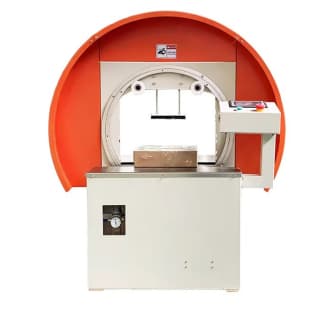
Built for exactly this kind of production environment, the P500 mini roll wrapping machine is designed for sealing packaging of cylindrical goods by rotating both the turntable and the roll itself, applying film evenly across the full surface. It's commonly used in paper making, cord fabric, non-woven fabric, and similar industries where consistent, moisture-resistant wrapping directly affects product condition on arrival.
The machine handles rolls with a diameter of 200–800 mm and a width of 200–500 mm, supporting a turntable capacity of up to 200 kg. Turntable speed is variable from 0–12 via frequency changer, allowing operators to adjust rotation speed according to roll weight and film requirements. Packing efficiency is rated at 20–40 rolls per hour, depending on roll size and wrapping settings.
The P500 is equipped with a pre-stretch film carriage capable of stretching film up to 250%, along with automatic film feeding to reduce manual adjustment. Its PLC control system allows wrapping layers and wrapping times to be set according to the product, giving it the flexibility to handle varied roll specifications on the same line.
7. Key Specifications
| Specification | Details |
|---|---|
| Model | P500 |
| Wrapping Size | Diameter 200–800 mm; Width 200–500 mm |
| Packing Efficiency | 20–40 rolls/hour |
| Turntable Speed | 0–12, variable via frequency changer |
| Turntable Capacity | 200 kg |
| Power Supply | 0.8 kW / AC380V |
| Film Carriage | Pre-stretch, up to 250%, automatic feeding |
| Machine Dimensions | 1460 × 840 × 1492 mm |
8. Is the P500 the Right Fit for Your Product Line?
If your operation regularly ships cylindrical rolls and manual wrapping is creating inconsistent protection or slowing down packing throughput, the P500 addresses both issues directly. Its adjustable turntable speed and PLC-based control make it adaptable across different roll sizes and weights, while automatic film feeding cuts down on manual handling at the packing station. Support is backed by field installation, commissioning and training, along with ongoing maintenance and repair service.
Get a Quote or Request a Test Run
Send us your roll diameter, width, and weight range, along with your target hourly output, and we'll confirm whether the P500 fits your line. We can also arrange a demo video or share the full machinery test report before you order.
Myway Machinery
Brand: Myway
Email: sales@syplastech.com